
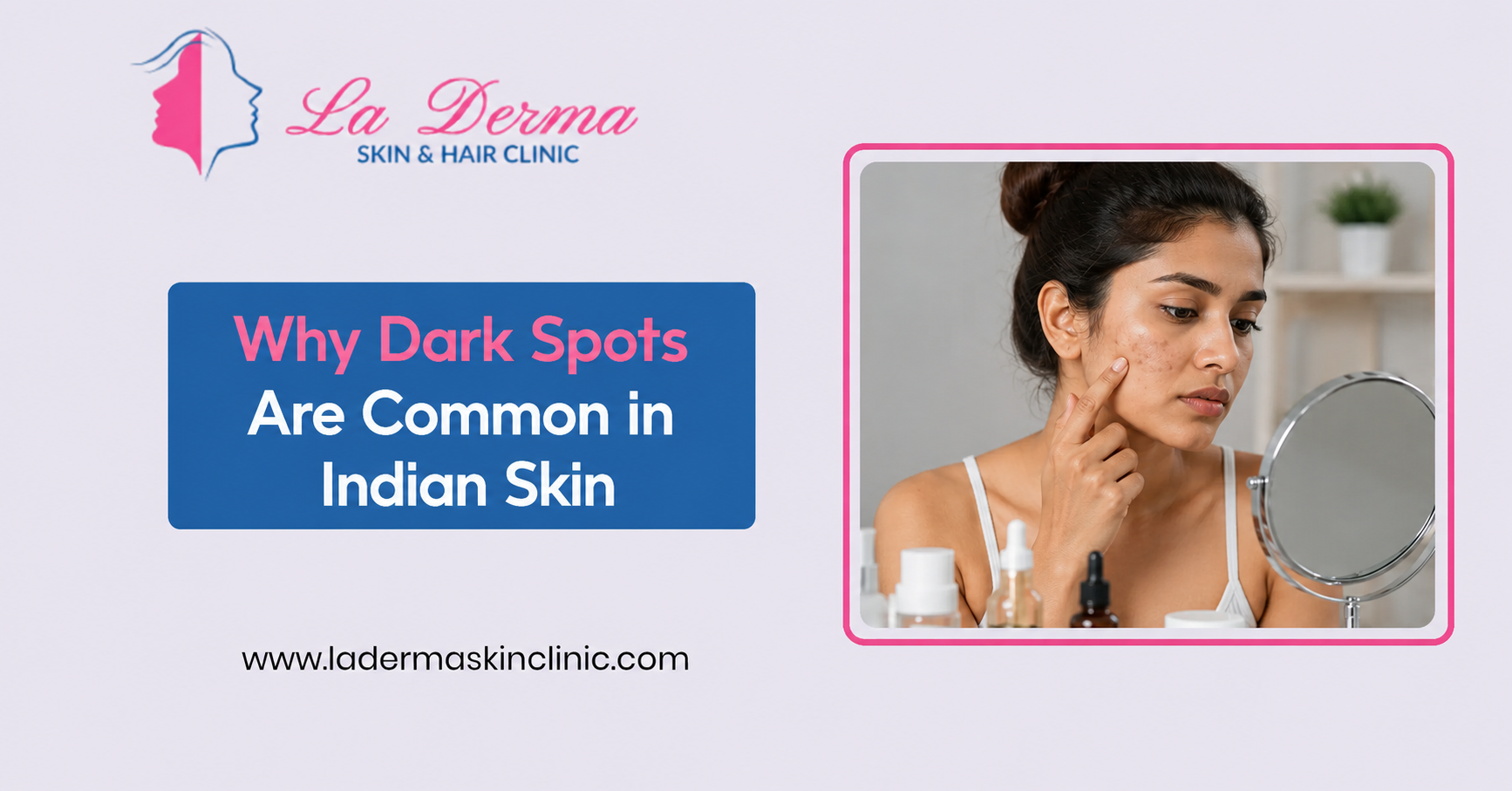
Why Dark Spots Are Common in Indian Skin
If you have ever looked in the mirror and seen patches of discoloration on your cheeks, forehead, or hands that just will not go away, you are not alone. Dark spots, which are also called hyperpigmentation, are a problem for people in India, and they can affect anyone no matter how old they are or what kind of skin they have. To deal with spots, you need to understand why dark spots happen in the first place.
As a doctor who specialises in treating spots, I see patients all the time who are confused about why they have these patches on their skin even though they use all sorts of creams and home remedies to get rid of dark spots. In this article, we will talk about what dark spots are, why dark spots are so common in Indian skin, and what really works to get rid of dark spots.
So what are dark spots really?
- Dark spots happen when your skin makes too much melanin. Melanin is the thing that gives your skin its color in areas.
- This can happen because of too much sun. It can also happen because of inflammation, changes in your hormones, or injuries to your skin.
- When this happens, it is called hyperpigmentation.
- Hyperpigmentation can look like a few things.
- It can look like sunspots. Sunspots are brown spots that you get from being in the sun too much.
- It can also look like melasma. Melasma is symmetrical brown or gray-brown patches. You usually get melasma on your face.
- Then there is post-inflammatory hyperpigmentation. Post-inflammatory hyperpigmentation is marks that you get after you have acne, cuts, or skin irritation.
- Then there are freckles. Freckles are spots that you are born with. Freckles get darker when you are in the sun.
Why is Indian skin more prone to dark spots?
1. Indian skin has melanin to start with.
Indian skin is usually classified as type IV to VI, which means it has more active melanocytes or pigment-producing cells than lighter skin types. This gives skin some natural protection against the sun, but it also means that it reacts to things like sun, inflammation, and hormonal changes by making more pigment, which can be seen more easily.
2. Indian skin gets a lot of sun.
Most of India gets sunlight for most of the year, which means that people’s skin is exposed to ultraviolet rays, which are the main reason that melanin is produced. When people commute to work outside or do not use sunscreen, they can get sun damage, which is one of the main reasons that dark spots happen.
3. Indian skin can get marks after it is injured.
Because Indian skin has reactive melanocytes, even small injuries, such as a pimple or a cut, can leave behind a dark mark that can last for months. This is a reason that people with acne in India often have dark spots long after their acne has gone away.
4. Hormonal changes can cause spots.
Things like melasma are often caused by changes in hormones, like when a woman is pregnant, when she is taking birth control pills or when she has a thyroid problem or PCOS. This is sometimes called the “mask of pregnancy.” It can happen to women who are not pregnant too.
5. Genetics play a role.
If your parents or siblings have pigmentation problems, you are more likely to have them, especially freckles and melasma.
6. The environment and lifestyle can cause spots.
Pollution, dust, and not taking care of your skin can cause stress in your skin, which can increase melanin production and make dark spots worse. Not eating well, not drinking water, not sleeping enough, and being stressed can also contribute to dark spots.
7. Not taking care of your skin can make dark spots worse.
Many people wait a long time to get treatment, or they use home remedies that are not proven to work, or they use harsh creams that can make their skin worse. This can make the pigmentation worse. Cause it to come back, which is a common problem that doctors see.
How are dark spots diagnosed?
To diagnose spots, a doctor will look at your skin and your medical history and figure out what is causing the problem. The doctor will look at:
- Your skin. How it reacts to the sun
- How deep the pigment is, using a light
- Your medical records. Any hormonal problems you may have
- How much sun you get and how you take care of your skin
- Any other skin problems you may have
This is why it is hard to get rid of spots on your own, because you need to figure out what is causing them in the first place.
What are some effective treatments for spots?
There are some dark spots treatment that can help get rid of them, including:
- Creams that you put on your skin that have ingredients like hydroquinone, tretinoin, azelaic acid, or vitamin C that can help reduce the amount of melanin in your skin.
- Chemical peels, which can help get rid of the layers of your skin and make your skin look better.
- Lasers, which can help break up the melanin in your skin and get rid of spots.
- Microneedling, which can help your skin absorb products better and make your skin look smoother.
- Sunscreen, which you need to use every day to prevent dark spots from forming and to protect your skin from the sun.
How can you prevent spots?
- Use sunscreen every day, even when you are inside or when it is cloudy
- Do not pick at your skin or try to pop pimples
- Use products that do not irritate your skin
- Drink plenty of water and eat a healthy diet
- Get checked for problems if you notice that you are getting dark spots
- Do not use home remedies that are not proven to work because they can make your skin worse
Why do you need to see a doctor to get rid of dark spots?
Dark spots are not a simple problem that you can fix with one product. What works for one person may not work for another. What works for one type of dark spot may not work for another. This is why you need to see a doctor, who can help you figure out what is causing your spots and give you a personalised treatment plan.
Dr. Khushbu Tantia, who is a known dermatologist in Kolkata says that the best way to get rid of dark spots is to combine different treatments, like creams, peels and lasers, with sunscreen and a healthy lifestyle. She also says that it is very important to get a diagnosis before you start any treatment because different types of dark spots need different treatments.
In the end, dark spots are a problem that can be treated if you know what you are doing. If you have spots and you do not know what to do, you should see a doctor, who can help you figure out what is causing them and give you a treatment plan that is just right for you.
People Also Ask:
Q: Are spots permanent?
No, dark spots are not always permanent. Many dark spots will go away with treatment and sun protection. However, some dark spots, like melasma, are deeper. May need to be managed all the time.
Q: How long does it take to see results?
The time it takes to see results for spots depends on the type of dark spots and how deep they are. You can usually see improvement in 6 to 12 weeks with treatments you put on your skin. You can see results faster with procedures done in a Dermatology Clinic.
Q: Can dark spots come back after treatment?
Yes, dark spots can come back after treatment. This happens if you do not protect your skin from the sun and take care of your skin. Skin that gets spots easily needs to be taken care of all the time, even after the dark spots go away.
Q: Is it safe to use home remedies for spots?
Most home remedies for spots are not safe to use because they do not have scientific proof that they work. Sometimes they can even irritate your skin. Make the dark spots worse. It is safer to talk to a dermatologist who can give you options that are based on science.
Q: When should I see a dermatologist for spots?
You should see a dermatologist for spots if they are getting bigger, changing shape or colour, or showing up suddenly. You should also see a dermatologist if your dark spots are not getting better with your skincare routine.