
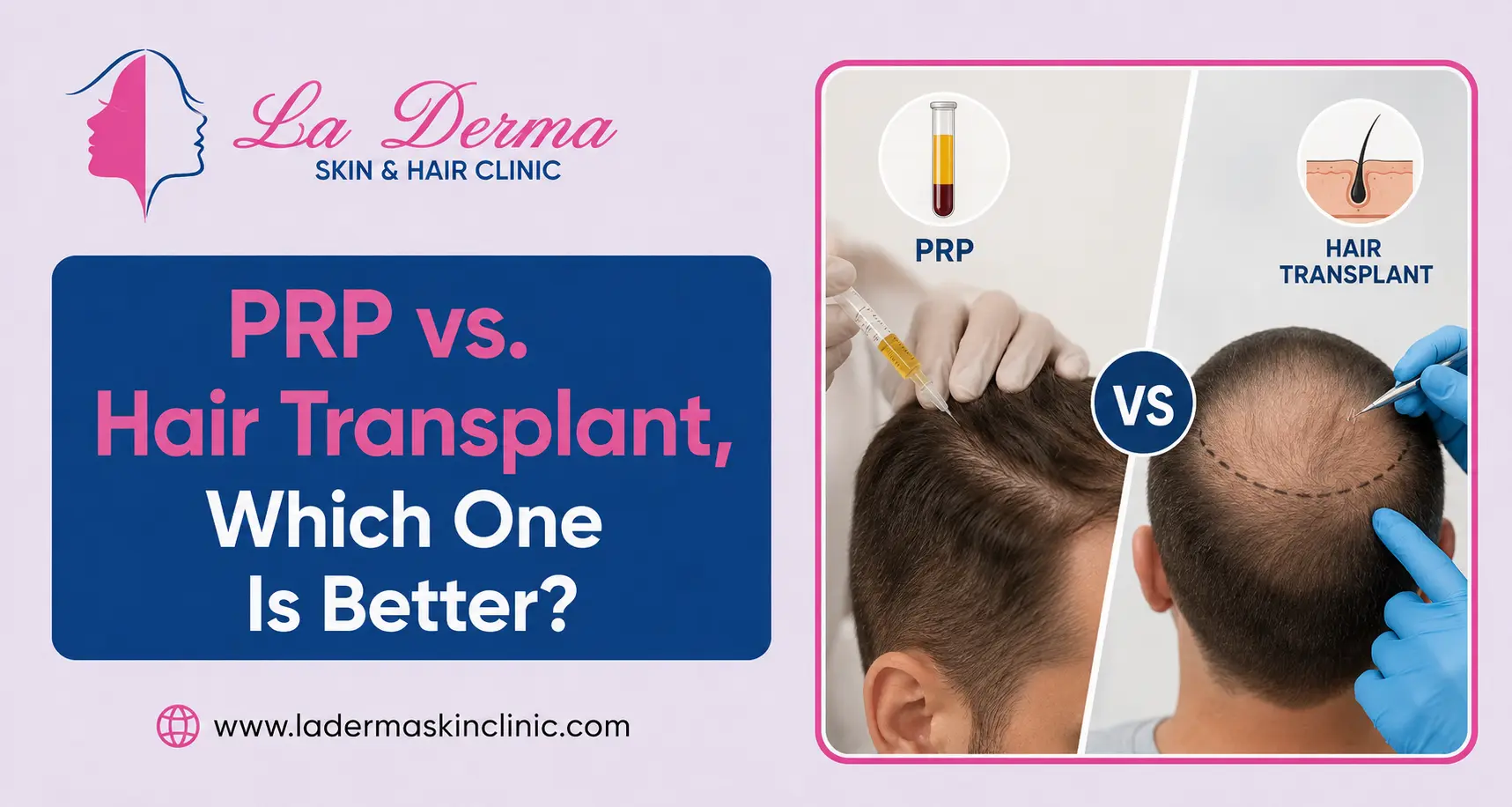
PRP vs. Hair Transplant, Which One Is Better?
Hair loss is among the most frequent cases seen at our clinic. Often, our clients find themselves confused, as they have already read contradicting information about PRP treatment and hair transplant on the Internet. While the first procedure is said to be a miracle treatment, the second one appears to be a temporary solution. But, the truth is that this is not always the case.
Having vast experience as Top Dermatologist who treat patients suffering from hair loss of various degrees, we can state with confidence that both PRP treatment and hair transplant can be equally effective provided that a patient is a good candidate for these procedures. The effectiveness of both methods depends on the state of the patient’s scalp, hair density, level of hair loss, client’s expectations from the procedure, and hair restoration goals in the long term.
Here, you will find information about the real difference between PRP treatment and hair transplant according to our clinical experience.
PRP Hair Treatment – How it Works?
PRP stands for Platelet Rich Plasma and is a procedure that uses the body’s healing cells from its own blood. A sample of blood is taken, spun to isolate the plasma containing platelets, and carefully injected into the thinning hair spots on the scalp.
Growth factors contained in PRP can activate weakened hair follicles, increase blood flow in the area and facilitate healthy hair growth.
It is worth emphasizing one thing that we always tell our clients about PRP, and it is the fact that this procedure does not grow any new hair follicles; it makes existing hair follicles healthier.
Understanding Hair Transplant
The Hair Transplant process involves transferring follicular units from an appropriate donor area, usually the back and sides of the scalp, to the recipient site, which is a balding or very thin part of the scalp.
This method differs from PRP because in Hair Transplantation, there is a physical transfer of follicles, which are permanently situated in the scalp. However, after surgery, it is necessary to protect the existing natural hair.
When Is PRP Recommended?
PRP treatment is most effective in cases of mild to moderate hair loss.
We usually recommend PRP when patients have:
Noticeable hair thinning
Increased hair fall
Widening hair part
Early male or female pattern baldness
Reduced hair density
Hair weakening after illness or stress
Patients are likely to retain their hair follicles, which react positively to stimulation.
The earlier a patient receives the treatment, the higher the possibility of saving the remaining hair.
When Should I Consider a Hair Transplant?
Hair transplant should be considered in case of non-existent hair follicles.
We generally recommend a transplant when patients have the following:
Large bald patches
Receding hairline with permanent hair loss
Advanced male pattern baldness
Areas where no visible hair growth has remained for years
Stable hair loss pattern
Once follicles are completely lost, PRP cannot bring them back. A transplant becomes necessary to restore hair coverage.
Hair Loss Stages and Suitable Treatment
Despite the fact that each person is unique, the treatment suggestions normally correlate with the stages of hair loss.
Stage 1: Hair Loss to a Minor Degree
Here, one experiences more hair loss, but scalp coverage is normal.
Suggested treatment: PRP treatment alongside medical and life style changes.
Stage 2: Thinning Hair
The hair thins out, its density goes down, and the scalp becomes more noticeable when lit brightly.
Suggested treatment: PRP treatment can bring very good results because follicles are still active.
Stage 3: Bald Spots Formation
Here, the patient gets small bald spots or a receding hairline.
Suggested treatment: PRP can save the hair around the bald spot, while some people plan their future transplantations.
Stage 4: Balding Moderately
The scalp becomes more visible, while there are a lot of inactive follicles.
Suggested treatment: In this case, transplantation is better, although PRP treatment will also enhance the existing hair.
Stage 5+: Advanced Balding
Extensive hair loss has occurred.
Hair transplant is usually the main method recommended, followed by PRP application to help transplanted hair grow and stimulate natural hair growth.
What Are The Most Common Results With PRP?
The first myth I can think of is the assumption that hair regrows instantly after just one PRP treatment.
It is normally not like that.
From what is commonly seen:
Hair loss typically begins to decrease in the initial weeks.
Hair thickness increases within the following few months.
Present hair looks healthy and more abundant.
Hair density shows improvement gradually.
Hair quality gets stronger and shinier.
Individuals suffering from initial hair loss will benefit from the most rewarding outcomes as their hair follicles are still alive.
What Are the Common Results of Hair Transplant?
Hair transplantation procedure ensures growth of hair in areas that are bald, but you have to be patient.
Typically:
Transplanted hair sheds initially.
New growth begins after several months.
Hair gradually thickens over time.
Final cosmetic results take many months to develop.
The hair that is transplanted stays permanent, but the surrounding hair, which has not been treated, continues thinning due to hair loss.
Can PRP and Hair Transplantation Procedures Be Used Together?
Yes, and this is something we frequently recommend in suitable cases.
PRP is often used:
Before transplant to improve scalp health
After transplant to support healing
To strengthen existing natural hair
To improve overall hair density
As part of long-term hair maintenance
A combination of both treatments usually results in a more balanced and natural-looking result than using one treatment alone.
PRP VS Hair Transplant: A Fair Fight
| PRP Therapy | Hair Transplant |
| Non-surgical treatment | Surgical procedure |
| Uses your own blood platelets | Moves healthy hair follicles |
| Best for thinning hair | Best for permanent bald areas |
| No stitches required | Minor surgical recovery |
| Helps strengthen existing follicles | Restores lost hair follicles |
| Requires maintenance sessions | Permanent follicle relocation |
| Minimal downtime | Short recovery period |
Both treatments do not replace each other as they address separate issues.
What is better?
Based on our experience, it all depends on the degree of your hair loss.
When you have healthy follicles but weak hair, then the PRP procedure can help to stop the process of hair loss and even improve the density.
When you have no follicles left and suffer from permanent baldness, then it’s better to opt for a hair transplant procedure.
In many cases, our patients are advised to use both techniques at once when the PRP technique preserves natural hair and a hair transplant restores bald spots.
Conclusion
One more point here is that there is no clear-cut winner between PRP and hair transplant because the two procedures are used for a different cause and give the optimal results only when applied at the correct phase of hair loss.
We will assist you to make your current hair follicles stronger, prevent further hair fall, and increase hair density. Being guided by Dr. Khushbu Tantia, you will be provided with an evidence-based individual treatment of your hair loss.
If you want to decrease early hair loss or increase hair density, then it is important to start treatment at the right moment.