
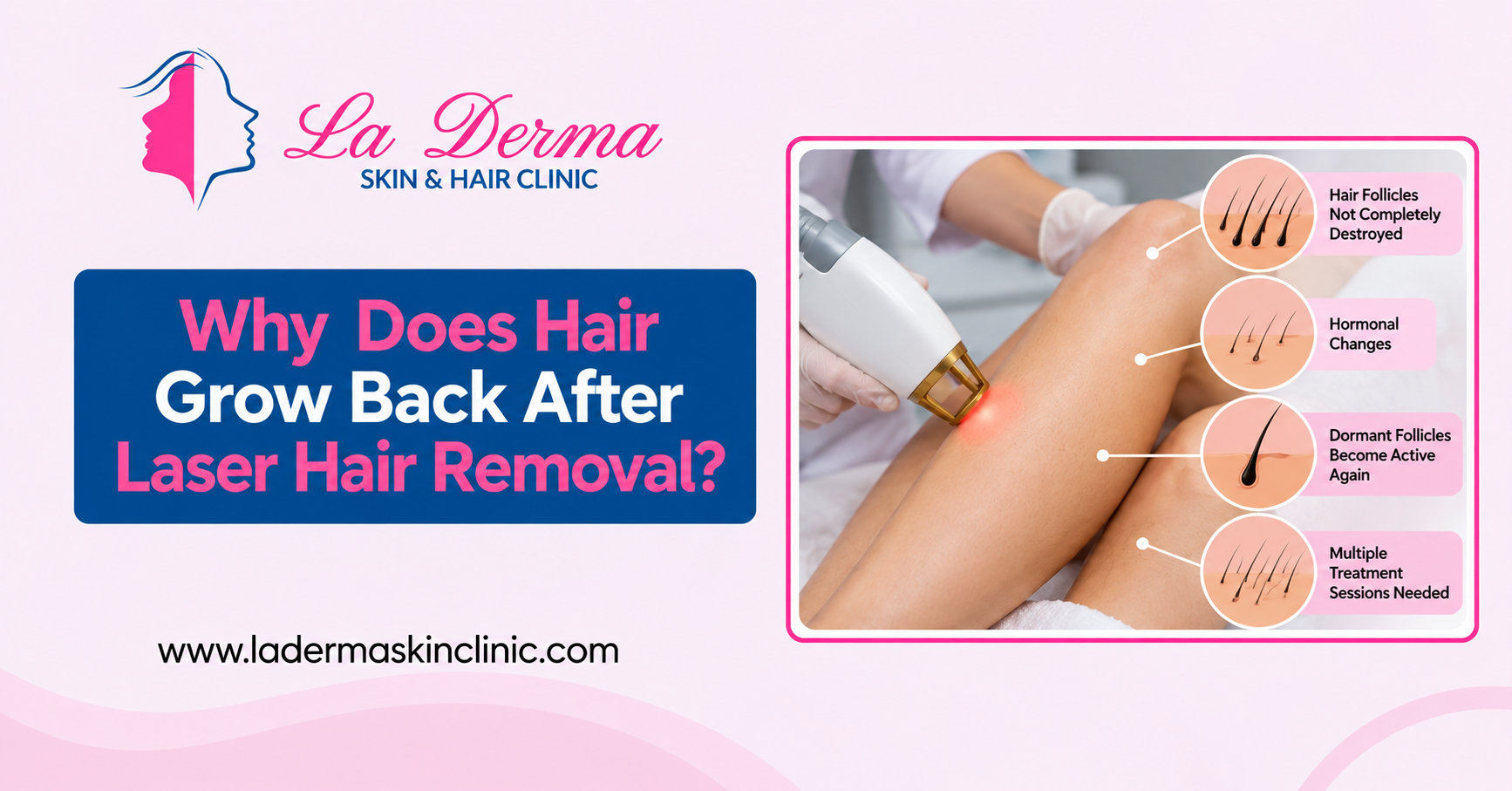
Why Does Hair Grow Back After Laser Hair Removal?
You finished your sessions, enjoyed months of smooth skin, and then one morning you noticed a few hairs where there were none. It’s frustrating, and many people start wondering if the treatment failed or their money was wasted.
It didn’t. Regrowth is far more common than most people expect, and there are clear, scientific reasons behind it. Anyone who has tried laser hair removal treatment in Kolkata or anywhere else has probably asked this same question at some point. In this guide, we explain why hair returns, what counts as normal, and how to get longer-lasting results.
The Short Answer
Hair grows back after laser mainly because the treatment offers permanent hair reduction, not permanent removal of every single hair. The natural hair growth cycle, hormones, missed sessions, hair colour, and device settings can all wake up follicles that weren’t fully disabled. The regrowth is usually finer, lighter, and sparser than before.
How Laser Hair Removal Works
A laser sends a focused beam of light into the skin. The pigment (melanin) in your hair absorbs that light and turns it into heat. The heat travels down to the follicle, the small pocket that produces the hair, and damages it so it can’t grow as well.
Here is the catch: the laser can only affect follicles that are actively growing and carry enough pigment at the time of the session. That one fact explains most cases of regrowth.
The Hair Growth Cycle Explained
Hair doesn’t grow all at once. Each follicle moves through three phases:
- Anagen (growth phase): The hair is actively growing and attached to the follicle. This is when laser works best.
- Catagen (transition phase): Growth slows and the follicle shrinks.
- Telogen (resting phase): The hair rests and eventually sheds, while the follicle stays dormant.
At any moment, only a portion of the hair in an area is in the growth phase. The rest is hidden from the laser. This is why one session never clears everything and why most people need six to eight sessions, spaced several weeks apart. Each visit catches a new batch of follicles as they enter the growth phase.
If you stop early, the dormant follicles wake up later and produce fresh hair. Think of it like mowing a lawn where only some blades are visible on any given day.
7 Common Reasons Hair Grows Back
1. Hormonal changes
Hormones are the biggest cause of stubborn regrowth. Conditions like PCOS, thyroid imbalance, and insulin resistance can stimulate new growth, especially on the chin, jawline, upper lip, and lower abdomen. Pregnancy, menopause, and certain medicines can do the same.
This is where a dermatologist in Kolkata can make a real difference. Persistent hair in these areas is often a sign of something happening inside the body, and treating the root cause alongside laser gives far better results than laser alone.
2. Too few sessions
Many people stop after three or four sessions because the area looks clear. But the dormant follicles haven’t had their turn yet. Completing the full course is the best way to prevent regrowth.
3. Irregular gaps between sessions
Sessions are timed around the growth cycle. Coming too early means missing follicles that haven’t surfaced yet, and coming too late means some hairs have moved past the ideal phase.
4. Light, grey, or fine hair
Lasers target pigment, so white, grey, blonde, or very fine hair responds poorly. Dark, coarse hair responds best. If your hair is on the lighter side, ask about realistic outcomes before you begin.
5. Wrong technology or settings
Indian skin, which typically falls in Fitzpatrick types III to V, needs devices and settings chosen with care. Energy that is too low won’t disable the follicle, and energy that is too high can burn or darken the skin. This is why clinics like La Derma Skin & Hair Clinic assess skin type and hair density first, and only then decide the laser settings.
6. Sun exposure and tanning
A tan makes treatment harder because the laser can mistake skin pigment for hair pigment. Clinics often lower the energy or delay the session, which reduces effectiveness.
7. Waxing, plucking, or threading during the course
These methods remove the hair root, leaving the laser nothing to target. Shaving is the only safe method between sessions.
Is It Regrowth or Just Shedding?
Many people don’t realise that treated hairs don’t fall out immediately. They can stay in the skin for one to three weeks before shedding, and they can look exactly like new growth.
True regrowth appears later, usually after the full course, and is typically thinner, softer, and lighter than the original hair. If you notice that change, the treatment is doing its job.
What Results Can You Realistically Expect?
With a proper course, most people see a significant reduction, often 70 to 90 percent, in hair density. The remaining hair is usually fine and easy to manage.
Some people need maintenance sessions once or twice a year, especially when hormones are involved. According to Dr. Khushbu Tantia, setting honest expectations before the first session is just as important as the treatment itself, because patients who understand the process are far more likely to complete the course and be happy with the outcome.
How to Reduce the Chances of Regrowth
- Complete the full course your clinician recommends, even if the skin looks clear halfway through.
- Keep to your schedule and avoid skipping appointments without a good reason.
- Shave only between sessions. Avoid waxing, plucking, and threading.
- Protect your skin from the sun with a broad-spectrum sunscreen, and avoid tanning before and after sessions.
- Get hormonal issues checked if you notice sudden or excessive hair growth.
- Follow aftercare advice. Avoid hot showers, saunas, and harsh scrubs for a few days after each session.
How to Choose the Right Clinic
Laser is a medical procedure, and results depend on who operates the machine and how well they understand your skin. Don’t choose on price alone. Ask who performs the treatment, which device is used, whether a skin and hormone assessment is done first, and how many sessions you realistically need.
A trusted skin care clinic in Kolkata will give you a personalised plan instead of a one-size-fits-all package. It will also explain the risks, show you what aftercare looks like, and be honest about what laser can and can’t do for your hair type.
If you’ve already had sessions elsewhere and still see hair, a fresh evaluation can often reveal what was missed, whether it was the settings, the gaps between sessions, or an untreated hormonal cause.
Final Thoughts
Hair growing back after laser doesn’t mean the treatment failed. It reflects how hair biology works. With a complete course, correct settings, good aftercare, and attention to hormones where relevant, most people enjoy long-lasting smoothness with only light maintenance.
If you’re unsure why your hair has returned, or you’re planning to begin treatment, a conversation with a qualified specialist is the best first step. Book a consultation with Dr. Khushbu Tantia at La Derma Skin & Hair Clinic and get a plan built around your skin.
Frequently Asked Questions
Does hair always grow back after laser hair removal?
Not always, and not the same way. Some follicles are permanently disabled, while others may recover. What returns is usually finer and lighter.
How long does it take for hair to grow back after laser?
Dormant follicles may produce hair weeks or months after a session. Hormonal regrowth can appear a year or more later.
Can hormonal problems cause hair to return?
Yes. PCOS and thyroid disorders can trigger new follicle activity, so a medical evaluation alongside laser gives better results.
Is laser hair removal really permanent?
It’s best described as permanent hair reduction. A large share of hair is lost for good, but maintenance sessions may be needed.
Can I shave between sessions?
Yes. Avoid waxing, threading, and plucking.
How many sessions do I need?
Most people need six to eight, depending on body area, hair type, and hormones.
Is laser safe for Indian skin?
Yes, when the right technology and settings are used by a trained professional.
What should I look for in laser hair removal treatment in Kolkata?
Look for a medically supervised setting, a proper skin and hair assessment, devices suited to Indian skin, and clear communication about the number of sessions and expected results.